
Emergency Water Extraction in Fordham, Bronx NY
Burst pipe, a ceiling leak from upstairs, or sewer water coming up through the cellar drain: we pump it out, dry the building properly and write down every reading. Day or night, in English or Spanish.
Water coming in right now? Do these five things first
- Stop the water if you canFor a toilet, sink or washer, turn the small valve behind or under it. If it's coming from the ceiling or a riser, get the super now. They can shut the line for the building.
- Stay clear of electricityIf water is near outlets, the panel or a light fixture, don't touch switches. Only turn off the breaker if you can reach it standing somewhere dry. Sparks or a burning smell: get out and call 911.
- If it came up a drain, treat it as sewageWater from a floor drain or toilet is sewage. Keep kids and pets out of it, and don't walk through it without boots and gloves.
- Take photos and video firstBefore you move anything, record the source, the ceiling, the floor and your belongings. That's your proof for the landlord and the insurance company.
- Tell your landlord or super in writingA text or email counts as a record. Then call us at [PHONE].
A person answers, 24/7
No voicemail at 2am. We dispatch while you're still on the phone.
Every reading documented
Moisture logs, dated photos and a drying report you can hand to anyone.
Built for walk-ups
We carry pumps and dehumidifiers up six flights and work with your super.
English or Spanish
We explain every step to you, the super and the owner in your language.
Water out fast. Building dried right. Every number written down.
Most of the damage from a leak happens after the water stops. It wicks into plaster, soaks the subfloor and runs down into the apartment below. That's why we treat extraction and drying as one job, and why we don't leave until the readings prove the materials are dry.
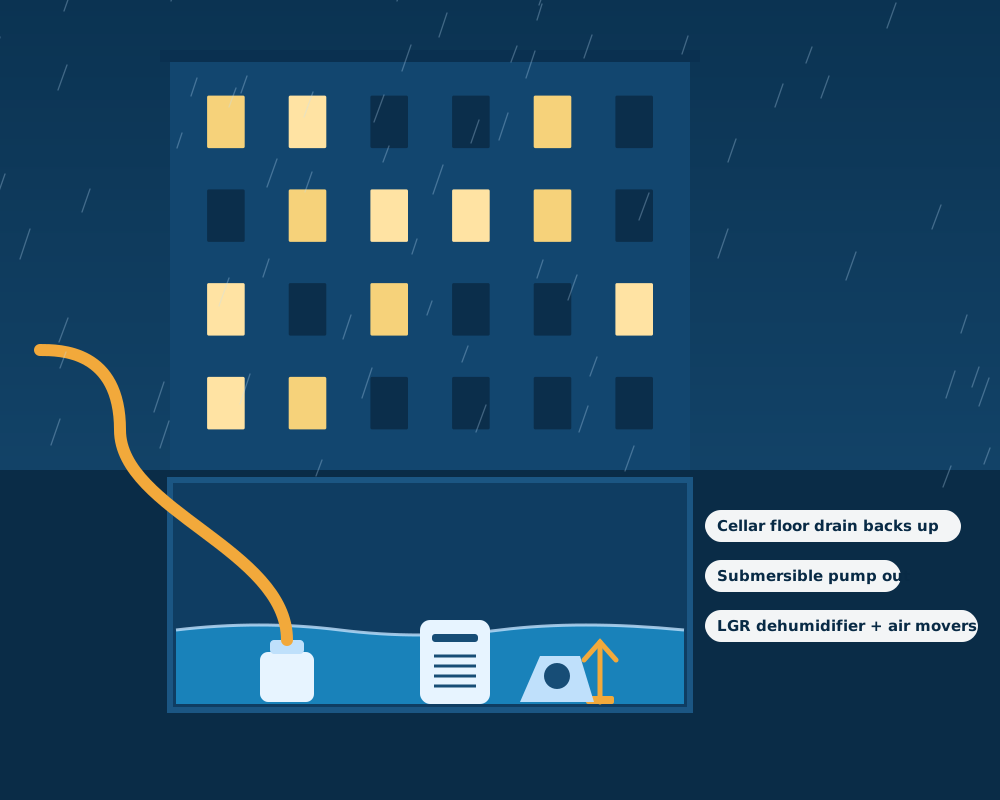
What our crew does when we get to your building
No two floods are the same, but the order of work is.
Find the source and the water category
Category 1 is clean water from a supply line. Category 2 is gray water from a washer or dishwasher. Category 3 is sewage or flood water from outside. The category decides what we can save and how we protect your family and our crew.
Extract
Submersible or trash pumps for a cellar with standing water. Truck-mounted or portable extractors for carpet, tile and hardwood. Pulling water out as liquid is far faster than waiting for it to evaporate.
Map the moisture
A thermal imaging camera plus pin and pinless moisture meters show where the water actually went: into the plaster, under the floorboards, down into the apartment below.
Dry it
Low-grain refrigerant (LGR) dehumidifiers and air movers, placed according to the readings. Where we can, we dry inside wall and ceiling cavities instead of tearing them open.
Clean and remove what can't be saved
Antimicrobial treatment where it's needed. After a sewage backup, soaked porous materials such as carpet pad and the bottom of drywall usually have to go.
Check and document
Daily readings, a photo log and a drying report you can hand to your landlord, your managing agent or your insurance adjuster.
Why can't I just use a shop vac and a couple of fans?
A shop vac gets some of the surface water. Fans on their own just move wet air around the room. The water that soaked into plaster, subfloor and the ceiling below stays there, and that's where mold starts. The EPA's guidance is to dry wet materials within 24–48 hours to prevent mold growth. That takes dehumidification and readings that prove the job is done.
How long does drying take?
Many clean-water jobs take about three to five days. Prewar plaster, masonry and hardwood often take longer. We don't take the equipment out until the readings say the materials are dry, and we'll show you those numbers.

Why Fordham buildings flood, and why it spreads so fast
Fordham's water problems come from its buildings, its sewers and its weather. Knowing which one you're dealing with changes the job.
Old pipes in old buildings
About 1,500 residential lots in ZIP 10458 date from 1900 to 1929, and walk-ups are the most common housing. Century-old risers, cast-iron stacks and galvanized lines fail, and water finds every apartment below and the cellar.
Cloudbursts and combined sewers
About 60% of NYC has combined sewers carrying rain and sewage in one pipe. In a hard downpour they back up through cellar floor drains. On October 30, 2025, Fordham got 2.34 inches in one storm.
Sewer backups are common
Since Hurricane Ida, New Yorkers have filed more than 113,000 flood reports with 311, and about half were sewer backups. That water is Category 3 and needs a sewage protocol.
Learn moreWater main breaks
In December 2024, an 1890s 48-inch main burst under Webster Avenue in Bedford Park, turning the avenue between East 201st Street and Moshulu Parkway South into a river. In January 2026, a break flooded part of Jerome Avenue during a cold snap.
Winter freezes and heat failures
Heat season runs October 1 to May 31, and the Bronx files more heat complaints than any other borough. When the boiler quits in a cold snap, pipes along outside walls freeze, and they usually burst when they thaw.
Learn moreEveryday leaks, stacked
An upstairs tub left running, a washing-machine hose, a water heater giving out, a roof or parapet leak after a nor'easter. With apartments stacked on top of each other, a small leak doesn't stay small.
Learn moreWater damage services in Fordham
Pick what you're dealing with. Each page explains what to do now, what we do on site, and who usually pays.
Flooded basement & cellar cleanup
Boiler rooms, storage cellars and basement apartments, pumped out and dried.
Learn moreSewer backup cleanup
Category 3 protocol: protective gear, safe removal of contaminated materials, disinfection.
Learn moreBurst pipe water damage
Risers, supply lines and stacks, traced and dried across every affected unit.
Learn moreFrozen pipe water damage
Pipes that burst when they thaw after a no-heat night.
Learn moreCeiling leak from upstairs
We trace it, dry both units and document both.
Learn moreWater removal & extraction
Pumps, truck-mounted and portable extractors for standing and soaked-in water.
Learn moreStructural drying
LGR dehumidifiers, air movers and daily readings to a documented dry standard.
Learn moreWhat it costs
The factors that move the price, and how insurance usually fits in.
Learn moreWe also handle: steam radiator and boiler leaks, roof and parapet leaks, water main break and storm flooding, appliance and water heater leaks, carpet and hardwood water extraction, contents pack-out and documentation, commercial and storefront water damage, and mold prevention after water damage.
Water where it shouldn't be?
Call now. We'll tell you what to do while a crew heads your way.
Built for how Fordham is actually built
- Six-floor walk-ups with no elevator. We carry pumps, extractors and dehumidifiers up by hand and plan for it, so a top-floor job doesn't wait.
- Plaster and lath. Old plaster holds water longer than drywall, and a soaked plaster ceiling can sag. We check whether it's safe and measure inside the wall before deciding anything has to come down.
- Cellars and boiler rooms. We work with the super on access, the boiler and the electrical, and pump out standing water before anyone works in it.
- Older buildings, older materials. Most buildings here were built before 1978, so we use lead-safe work practices when painted surfaces get disturbed, and check old pipe insulation and floor tile before any demolition.
- Fordham Road traffic. We stage on side streets and run hoses and equipment in from there, so a storefront job doesn't block the street.
- Co-ops along the Grand Concourse. We coordinate with the managing agent and the board, and document where the water came from and where it went. That record decides who's responsible.

Who pays for water damage in a Fordham apartment?
This is the question everyone asks first. These are the usual answers in NYC. Every lease and policy is different, and this isn't legal advice.
If you rent
Fixing the building (walls, ceilings, floors, pipes) is generally the landlord's job. Your belongings fall to you or your renters insurance. Storm water from outside may count as "flood," which many renters policies don't cover.
If it came from upstairs
Your own insurance is usually the fastest way to get your unit dealt with. The insurance companies sort out whose fault it was afterward.
Co-op or condo
The proprietary lease or bylaws split who handles what. Your own policy usually covers your unit's interior and belongings; the building's master policy covers common parts.
If you own a house
A sudden pipe burst is often covered. A sewer backup usually isn't, unless you added a water backup endorsement. Flood water from outside needs a separate flood policy.
Landlords and mold
Under NYC's Local Law 55, owners of buildings with three or more apartments have to keep apartments free of mold and fix the leaks that cause it.
Learn moreCall your insurer or us first?
Stop the damage first. Most policies expect you to keep it from getting worse. Then call your agent with our photos, readings and estimate in hand. A small loss may come in under your deductible.
Learn moreOne call for the whole building
- A direct 24/7 line that gets a person, and one point of contact for the whole job.
- Every unit gets checked. On a riser or stack leak, we check each apartment below the source and the cellar, not just the unit that called.
- Paperwork your carrier will take: moisture logs, dated photos, drying reports and [Xactimate-format estimates, if the operator uses them].
- Staying ahead of HPD: fast extraction, verified drying and removing wet material keep a leak from turning into a mold violation. In a building with 10 or more apartments, mold over 10 square feet requires a NYS-licensed mold assessor and remediator, and we'll tell you if you've crossed that line.
- Tenants kept in the loop: our bilingual crew explains what's happening at the door, so your phone rings less.
- Vendor setup: certificate of insurance and W-9 on request.

What emergency water extraction costs in Fordham
The price depends on the job. These are the things that move it up or down.
Water category
Clean water costs least. Sewage (Category 3) costs more because of protective gear, removing contaminated materials and disinfection.
How far it spread
Square footage, and how many apartments and floors are affected.
How long it sat
Water left overnight soaks deeper into plaster, subfloor and the ceiling below.
Materials
Plaster, hardwood and masonry dry slower than drywall and tile.
Equipment days
How many dehumidifiers and air movers, for how many days.
Access
Floors carried by hand, cellar access, and after-hours work.
Before you let anyone in, check the license
In New York City, any company doing more than $200 of home improvement work on a residential building needs a Home Improvement Contractor license from the Department of Consumer and Worker Protection (DCWP). Ask for the license number and look it up on DCWP's site or by calling 311. Ours is #[HIC #].
Red flags
- Cash only, or no written contract
- No license number, or one that doesn't check out
- Pressure to sign on the spot
- A crew that wants to tear things out before anyone has measured anything
Fordham neighborhoods and ZIP codes we serve
We cover all of Fordham (10458, 10468, 10457 and 10453) and the neighborhoods around it. If you're near the Rose Hill campus of Fordham University, the New York Botanical Garden or the Bronx Zoo, you're in our area.
10458 · 10468Fordham & Fordham Manor
Fordham Road, the Grand Concourse, Webster, Valentine and Ryer Avenues, Fordham Plaza
 10453 · 10468
University Heights & Fordham Heights
Jerome Avenue, University Avenue, near Poe Park
10458Bedford Park
Webster Avenue, Bedford Park Boulevard, toward Moshulu Parkway
 10458 · 10457
Belmont & Arthur Avenue
Restaurant and shop cellars in the Bronx's Little Italy
 10468
Kingsbridge Heights & Jerome Park
Around the Kingsbridge Armory and Kingsbridge Road
 Nearby
Norwood & Tremont
Just north and south of Fordham
¿Se le está metiendo agua?
¿En el apartamento, el sótano o el negocio? Llámenos a cualquier hora. Nuestro equipo habla español y le explica todo: a usted, al súper y al dueño.
En español, de principio a fin
- Le contestamos en español, de día o de noche
- Le explicamos quién suele pagar
- Hablamos con el súper y con el dueño, si usted quiere
Get ready for the next storm or freeze
Sign up for Notify NYC
Get flash-flood warnings for the Bronx by text or email from Notify NYC.
Check your block
Look up your street on the NYC DEP Stormwater Flood Map.
Own the building?
Ask a licensed plumber about a backwater valve, and ask your agent about a water backup endorsement and a separate flood policy.
Keep valuables off cellar floors
Shelves or plastic bins, not cardboard boxes on the floor.
Before winter
Find your shutoff valves. Report a no-heat apartment to 311 right away. Pipes along outside walls freeze first.
Learn moreKnow the first five steps
Bookmark our step-by-step guide so you're not searching while water is coming in.
Learn moreFrequently asked questions
How fast can you get to my building in Fordham?
Our typical arrival in Fordham is [ARRIVAL WINDOW]. We answer 24/7 and dispatch as soon as you call. Have the super's number or building access ready if you can.
Is the water coming through my ceiling or floor drain dangerous?
It can be. Water from a clean supply pipe is Category 1. Water from a washer or dishwasher is Category 2. Water that came up a floor drain or toilet, or came in from the street, is Category 3: sewage or flood water. Keep kids and pets away from it, don't touch it bare-handed, and stay away from wet outlets and fixtures.
Do I have to pay if my apartment flooded from upstairs?
In most NYC rentals, repairing the building is the landlord's responsibility, and your belongings fall to you or your renters insurance. Document everything, tell your landlord in writing, and report it to your insurer. If the landlord doesn't act, you can file a complaint through 311. Our who-pays guide walks through each situation.
Does homeowners insurance cover a sewer backup in New York?
Usually not, unless you added a water or sewer backup endorsement to your policy. Flood water from outside generally needs a separate flood policy. Check your declarations page or call your agent.
Will my apartment get mold?
It can if things stay wet. The EPA's guidance is to dry wet materials within 24–48 hours to prevent mold growth. Quick extraction and dehumidification, with readings that confirm everything is dry, is how we prevent it.
Do you have to open up my walls or ceiling?
Not always. We find where the water went with thermal imaging and moisture meters first, and dry inside the cavity when we can. After a sewage backup, soaked drywall and carpet pad usually have to be removed for health reasons.
Will you talk to my landlord, super or insurance adjuster?
Yes, with your permission. We give them the same photos, readings and drying report we give you.
¿Hablan español?
Sí. Atendemos llamadas en español las 24 horas, y nuestro equipo le explica cada paso en español. Ver la página en español.
Are you licensed and insured?
Yes. NYC DCWP Home Improvement Contractor license #[HIC #], [IICRC CERTS], insured by [INSURANCE]. Ask for proof anytime.
How do I keep my basement from flooding again?
Check your block on the NYC DEP Stormwater Flood Map, sign up for Notify NYC, keep floor drains clear, and ask a licensed plumber whether a backwater valve makes sense for your building. Make sure your insurance includes water backup coverage.