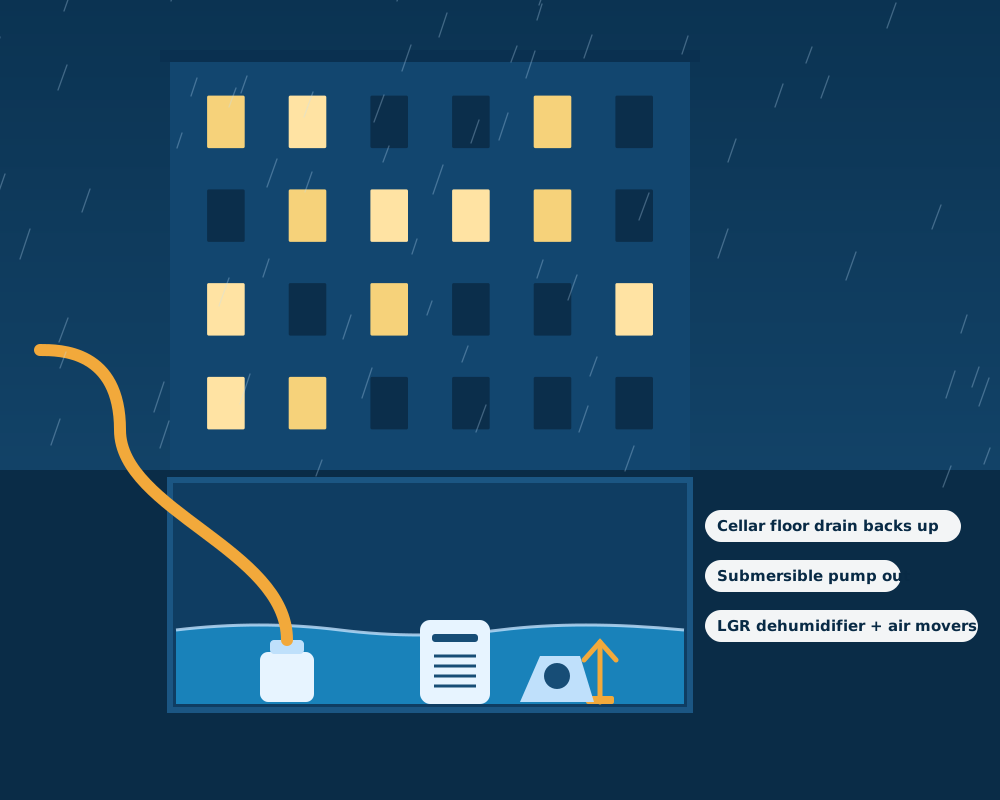
Why sewer backups happen so often in the Bronx
About 60% of New York City has combined sewers, meaning the same pipe carries rainwater from the street and wastewater from buildings. In a heavy downpour those pipes fill up. When they do, water pushes back up through the lowest openings it can find: cellar floor drains, basement toilets and laundry sinks.
It isn't rare. A flood map released by Rebuild by Design in August 2026 counted 113,481 flood reports to 311 since Hurricane Ida, and about half of them (49.2%) were sewer backups. Backups can also happen in dry weather when a building's own house trap or sewer line is clogged.
Is sewer backup water dangerous?
Yes. The water damage industry standard (IICRC S500) puts water from beyond the toilet trap, sewage and flood water from outside in Category 3, the most contaminated class. It can carry bacteria and viruses. That's why:
- We wear protective gear, and you shouldn't touch it bare-handed.
- Food, medicine and anything that touches your mouth that got wet should be thrown out.
- Soaked carpet, padding, upholstered furniture, mattresses and cardboard usually can't be safely cleaned.
- Drywall and insulation that wicked up the water are usually cut out above the waterline.
How we clean up a sewer backup
- Stop the inflow. If it's a storm backup, it usually stops when the sewer drains. If it's a building clog, the super or a plumber has to clear the line. Until then, nobody in the building should run water.
- Contain and protect. We set up containment where needed so contamination doesn't get tracked through the building.
- Remove the water. Pumps and extractors take out standing water and sludge.
- Remove what can't be saved. Porous materials that took on sewage are bagged and removed. Drywall is cut out above the visible waterline.
- Clean and disinfect every hard surface the water touched, with EPA-registered products.
- Dry and verify. Structural drying with dehumidifiers and air movers, with daily moisture readings until the space reaches the dry standard.
- Document. Photos before, during and after, plus readings and a list of what was removed, for the owner and the insurer.
Can I clean up a sewer backup myself?
A small backup on a sealed concrete floor, caught right away, can sometimes be handled with protective gear, disinfection and good ventilation. Anything that reached carpet, walls, a finished basement or a living space is a different job. If in doubt, call and describe it: we'll tell you honestly whether you need us.
Who pays for sewer backup cleanup?
This catches a lot of homeowners off guard. A standard homeowners policy usually excludes sewer backup unless you added a water or sewer backup endorsement. Flood water from outside generally needs a separate flood policy. In a rental, cleaning and repairing the building is generally the landlord's job; your belongings fall to you or your renters insurance. More in our who-pays guide.
Stop the next one
- Report it to 311. DEP can inspect the sewer in your street, and the report becomes part of the record.
- Ask about a backwater valve. DEP has evaluated backwater valves as a tool for preventing basement sewer backups; a licensed plumber can tell you if one fits your building.
- Don't pour grease down drains or flush wipes. Blockages in building lines cause dry-weather backups.
- Check your coverage for a water backup endorsement before the next storm.